The Sanctuary Ritual: Designing the Walk-In Closet as a Private Boutique in 2026
The walk-in closet has quietly become the most psychologically charged room in a high-end home. Firms like Modenese Bespoke — a foremost classic and contemporary Italian walk-in closet and kitchen company with a singular portfolio and unmistakable aesthetic vocabulary — have spent years arguing that getting dressed should feel less like a chore and more like a curated act. In 2026, that argument has won. The residential closet design industry in the United States alone is valued at over $14 billion, with the premium custom segment growing at roughly 6.8% annually, driven by homeowners who now allocate the same per-square-foot budget to their dressing room as they once reserved for a primary kitchen remodel. The shift is not cosmetic. It reflects a documented behavioral pattern: people who spend time in aesthetically intentional spaces report measurably lower cortisol levels during morning routines, according to environmental psychology research published by institutions including the American Psychological Association’s Environment and Behavior journal.
From Storage to Stage: The Conceptual Shift Driving 2026 Closet Design
For most of the twentieth century, closet design was an exercise in compression. The goal was fitting more into less space — more hanging rods, more shelving, more shoe cubbies. That paradigm has inverted. The defining metric in 2026 premium closet design is not capacity per square foot but experience per square foot. Designers are borrowing directly from high-end retail architecture: the way a luxury boutique controls sightlines, manages lighting temperature, sequences material reveals, and creates moments of pause.
This is not purely aesthetic philosophy. The U.S. Census Bureau’s Survey of Construction shows that new single-family homes completed in 2024 averaged a primary bedroom suite footprint 18% larger than 2014 equivalents, with dedicated dressing rooms appearing in 34% of homes priced above $750,000 — up from 21% a decade earlier. The room is growing because demand is clear and measurable.
What designers call the “boutique model” rests on four physical principles: controlled light, tactile material contrast, visible curation, and a functional focal point. In a high-end retail environment, those translate to spotlit displays, velvet and polished steel, edited product selection, and a central island or counter. In a private dressing room, the translation is nearly literal.
The Anatomy of a Boutique-Model Walk-In Closet
The Glass-Top Island: Function as Jewelry
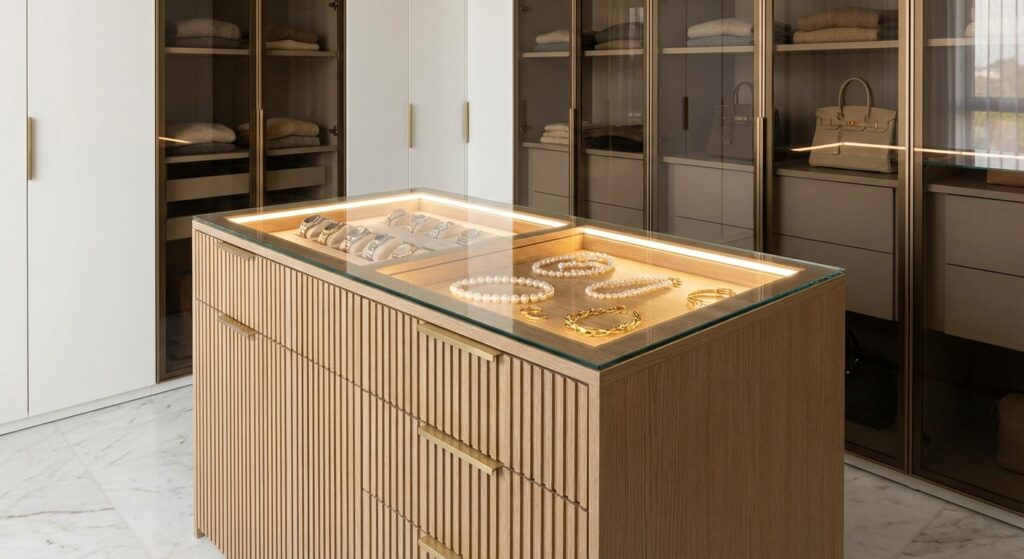
The jewelry-box island is the single piece of furniture most responsible for the boutique feeling. A well-specified island in a 2026 premium installation measures between 36 and 48 inches in height (counter height, not table height — the distinction matters for prolonged standing use), runs between 48 and 72 inches in length, and features a glass-inset top over a backlit cavity holding watches, fine jewelry, or folded accessories. The glass is typically 10mm tempered clear float glass set into a hardwood or lacquered MDF frame, with LED strip lighting running at 2700K to 3000K color temperature — warm enough to render skin tones accurately without the yellow cast of older halogen systems.
Below the glass, the drawer configuration follows a specific logic. Top drawers, closest to eye level when opening, hold items accessed daily. Deeper lower drawers hold seasonal pieces. Velvet-lined interiors are not a decorative choice alone: the pile surface prevents micro-scratches on metal clasps and watch crystals, and reduces sliding friction that damages delicate fabrics. The preferred velvet specifications among Italian manufacturers currently range from 320 to 380 grams per square meter, in short-pile construction (2-3mm), typically in neutral tones — dove, slate, or deep navy — that do not visually compete with the objects inside.
Integrated Vanity Nooks
The vanity nook within a dressing room — distinct from a bathroom vanity — solves a specific spatial and behavioral problem. When makeup application, hair styling, and accessory selection happen in the same room as the clothing, the morning sequence becomes continuous rather than fragmented across rooms. Fragmented routines are measurably longer: a 2023 time-use study from the Bureau of Labor Statistics American Time Use Survey found that adults in the United States averaged 37 minutes on morning personal grooming activities, with multi-room routines running approximately 12 minutes longer than consolidated single-room equivalents.
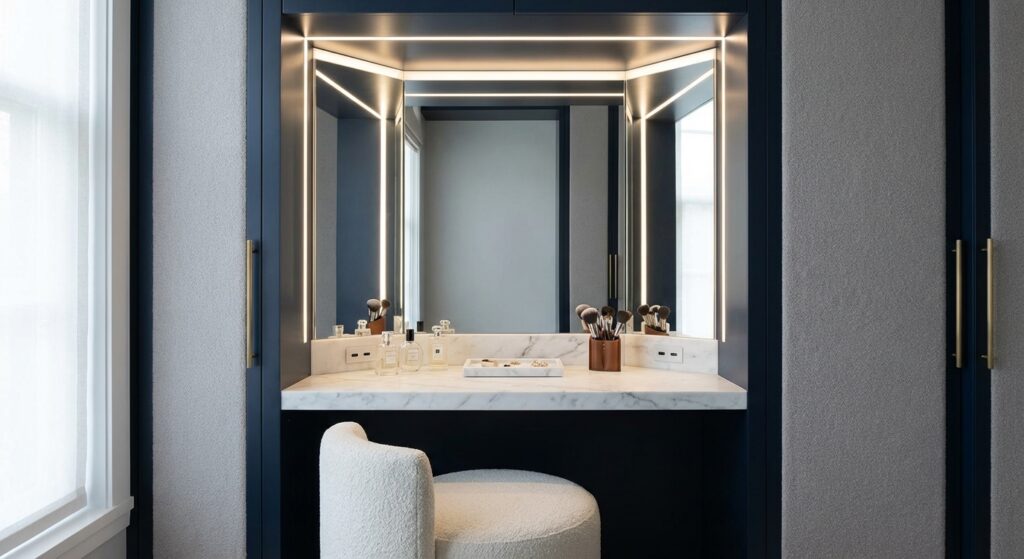
A properly designed integrated vanity nook includes a mirror lit from three sides (not top-only, which creates unflattering shadows), a surface depth of at least 20 inches to accommodate professional-grade tools, and dedicated power with USB-C outlets recessed into the counter edge. The mirror itself — increasingly specified as a smart mirror with adjustable color temperature between 2700K (candlelight) and 6500K (daylight) — allows accurate application in both indoor and outdoor lighting simulations.
Lighting Architecture
Lighting in a boutique-model closet operates in layers, following the same logic used by luxury retail architects. The three layers are ambient (overall room fill), task (specific work surfaces and mirrors), and accent (display illumination for shelves, islands, and back panels). Each layer is independently controlled, typically via a scene-based dimmer system that allows preset “morning,” “evening,” and “display” modes.
| Lighting Layer | Recommended Color Temperature | Typical Fixture Type | Primary Function |
|---|---|---|---|
| Ambient | 2700K–3000K | Recessed downlights or cove LED | Room fill, shadow reduction |
| Task (Vanity) | 3000K–4000K (adjustable) | Side-mount LED strips or Hollywood-style bulb bars | Accurate color rendering for makeup and grooming |
| Accent (Display) | 2200K–2700K | Low-voltage LED puck lights or micro-spotlights | Jewelry, watches, handbag illumination |
| Back Panel / Wardrobe Interior | 3000K | Motion-activated LED strips inside cabinetry | Garment visibility, color accuracy in selection |
Materials That Define the Premium Tier
The material palette in a 2026 boutique-model closet is selective by design. The Italian manufacturing tradition — which firms like Modenese Bespoke have refined over decades — operates on the principle that every surface the hand comes into contact with should have a considered tactile property. That means the inside of a drawer feels different from its face, the back panel of a wardrobe feels different from its door, and the floor underfoot is distinct from every vertical surface.
| Material | Application Zone | Key Specification | Why It Works in a Dressing Room Context |
|---|---|---|---|
| Lacquered MDF (matte) | Cabinet doors, drawer faces | Polyurethane topcoat, 40–60 gloss units | Fingerprint resistance, depth without reflective distraction |
| Fluted oak veneer | Accent panels, island faces | 0.6mm natural veneer, CNC-routed profile | Tactile rhythm, visual warmth without grain complexity |
| Bouclé fabric panels | Back walls, padded door inserts | Class 1 fire-rated contract bouclé | Acoustic softening, premium textile feel |
| Brushed brass hardware | Handles, rod brackets, mirror frames | PVD-coated solid brass, satin finish | Durability with warm tonal consistency across elements |
| Smoked glass | Display cabinets, upper doors | 6mm tinted tempered, bronze or grey | Visible but softened display — suggests without fully revealing |
| Honed marble or sintered stone | Island top alternative | 20mm slab, honed finish (not polished) | Honed finish is non-reflective, shows true color, less fingerprint-visible |
Spatial Requirements and Planning Standards
A functional boutique-model dressing room requires a minimum clear floor area of 100 square feet to achieve the full spatial effect. Below that threshold, the island either disappears or circulation becomes compromised. The National Kitchen and Bath Association, whose residential design standards are referenced in project specifications across the United States, recommends a minimum 36-inch clear walkway in dressing and closet environments — a standard that expands to 42 inches in luxury-tier installations to allow drawers and doors to open simultaneously without blocking passage.
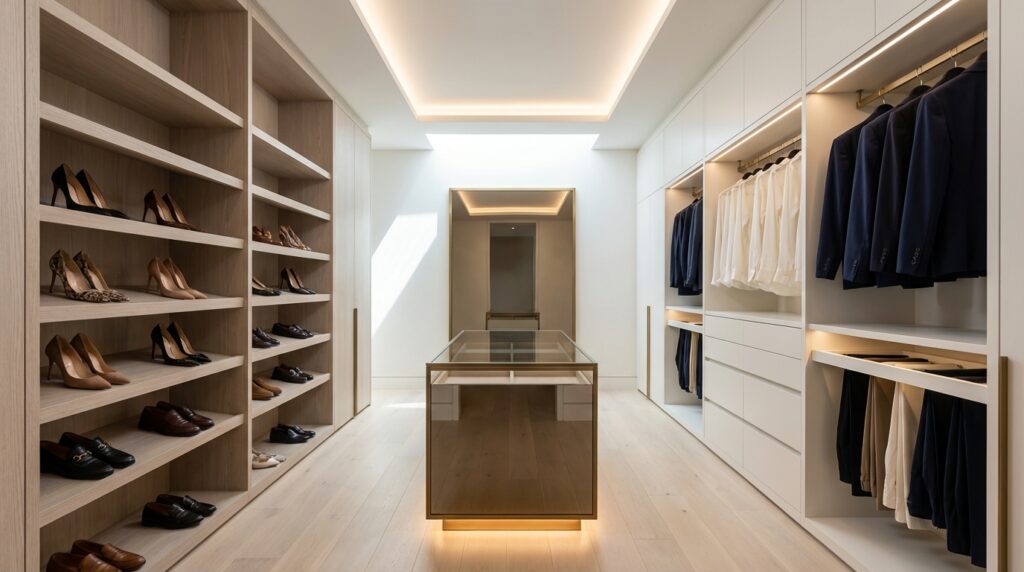
Ceiling height carries outsized importance in this room type. A ceiling below 9 feet suppresses the vertical display capacity that makes full-length hanging sections read as dramatic. The ideal range for a premium installation is 10 to 11 feet, allowing double hanging (two rods at approximately 44 inches and 72 inches from the floor) for shorter garments, alongside full-length hanging sections of 68 to 72 inches clear height for gowns and coats.
| Closet Category | Minimum Floor Area | Ideal Ceiling Height | Island Feasibility | Dedicated Vanity Nook |
|---|---|---|---|---|
| Reach-in (standard) | Under 20 sq ft | 8 ft | No | No |
| Walk-in (functional) | 40–80 sq ft | 9 ft | Possible (small) | Possible (compact) |
| Dressing room (boutique entry) | 100–150 sq ft | 9.5–10 ft | Yes (36″–48″ island) | Yes (integrated) |
| Dressing suite (full boutique) | 150–300+ sq ft | 10–12 ft | Yes (full island with seating) | Yes (dedicated zone) |
The Morning Ritual as a Behavioral Design Problem
The framing of a dressing room as a “ritual space” is not metaphor — it has measurable behavioral foundations. Research published through the National Institutes of Health on environmental enrichment and stress response consistently shows that physical environments with intentional aesthetic order reduce decision fatigue and lower morning cortisol spikes. When a dressing room is organized around the logic of display — garments visible and categorized, accessories curated rather than stored — the selection process requires less working memory and less time.
This has practical design consequences. Open shelving for folded items should show no more than three visible layers deep, because the human eye stops registering items at the fourth layer without direct inspection. Shoe display works best at 5 to 65 inches from the floor — the range where items are visible without crouching or eye strain. Hanging sections should be organized by garment weight and length rather than by color, because weight-and-length organization aligns with how people actually choose what to wear (occasion-based, temperature-responsive) rather than how they think they choose (visually).
Fragrance Integration
The fragrance dimension of a boutique-model dressing room represents one of the more considered choices in a premium installation. Several Italian furniture manufacturers now offer dedicated fragrance drawer inserts — essentially shallow cedar-lined trays with replaceable scent tablets — positioned near the garment sections to impart a subtle, consistent ambient note. The cedar backing serves both a functional role (moth deterrence, humidity management) and a sensory one. The scent should be entirely neutral relative to any perfume applied at the vanity: cedar, bergamot, or white tea are the most commonly specified because they have minimal projection and dissipate without lingering on fabric.
Technology Integration: What Belongs and What Doesn’t
Smart home technology in the walk-in closet is a field that has produced as many poor installations as good ones. The distinction between useful integration and gadget accumulation comes down to whether the technology reduces friction in the morning routine or adds to it. According to a 2024 residential technology survey conducted by the U.S. Department of Energy, LED lighting systems with scene control represent the highest-satisfaction smart home feature in bedroom and dressing room environments — consistently outranking voice-activated mirrors, automated drawers, and wardrobe management apps in user retention after 12 months.
- High ROI integrations: Scene-based LED lighting with single-touch presets, motion-activated cabinet interior lighting, integrated USB-C power at the vanity counter, and climate-control zoning that keeps the dressing room slightly warmer than the adjacent bedroom (68–70°F vs. 65–67°F, the standard specification).
- Low-ROI integrations: automated rotating shoe carousels (high maintenance, noisy), voice-controlled mirror displays (screen glare interferes with makeup application), RFID garment-tracking systems (requires tagging every item, typically abandoned within 6 months).
- Conditional integrations: Steam units built into hanging sections (high value for frequent travelers returning from trips; low value otherwise), motorized mirror panels (useful in narrow rooms where a swing-out mirror would block circulation), and heated flooring (high satisfaction in climates with average winter temperatures below 40°F).
Investment Benchmarks and Cost Architecture
The cost of a boutique-model walk-in closet in the United States in 2026 breaks down differently than most homeowners expect. Cabinetry and millwork typically account for 40–50% of the total project cost. Lighting accounts for 15–20% in a fully specified installation — a much higher proportion than in standard residential projects, reflecting the layered system and quality of fixtures. The island, if custom-fabricated, runs between $4,500 and $18,000 depending on material specification and size. Installation labor in major metro markets currently runs $85–$145 per hour for finish carpentry of this caliber.
| Project Tier | Total Investment Range (USD) | Primary Material Spec | Island Included | Custom Lighting System |
|---|---|---|---|---|
| Premium (entry boutique) | $25,000 – $55,000 | Lacquered MDF, standard hardware | Optional | Basic scene control |
| Luxury (full boutique) | $55,000 – $130,000 | Veneer, solid wood details, PVD hardware | Yes | Full layered system |
| Ultra (Italian bespoke) | $130,000 – $400,000+ | Solid wood, marble, custom upholstery | Yes (with seating) | Architectural integration |
Return on investment for a dressing room renovation is harder to isolate than for kitchen or bathroom remodels because real estate appraisers do not categorize it separately. However, a 2023 analysis from the National Association of Realtors Research Group found that homes with dedicated dressing suites in the $1M+ price bracket sold at a 4–7% premium over comparable homes without one, with shorter days-on-market in the same cohort.
The Italian Manufacturing Standard: Why It Remains the Reference Point
Italian closet manufacturing occupies its position not because of cultural mystique but because of specific production capabilities that most other markets have not replicated at scale. The Brianza furniture district in Lombardy, along with clusters in the Veneto and Friuli Venezia Giulia regions, maintains production ecosystems in which lacquer application, veneer pressing, hardware sourcing, and CNC precision work are carried out within close geographic proximity. That proximity reduces lead times, enables faster design iteration, and allows quality control at each production stage in a way that distributed global supply chains do not easily replicate.
The tolerances matter. Italian premium cabinetry is typically specified to ±0.5mm in door-to-door alignment and gap consistency, compared to ±1.5–2mm in standard mass-market production. In a room where the entire aesthetic depends on precision reveals, consistent shadow gaps, and flat door faces, that 1mm difference is visible to the naked eye. It is the difference between a room that reads as a boutique and one that reads as a well-organized storage space.
For homeowners in the United States, Europe, or the Gulf states evaluating this category, sourcing directly from established Italian manufacturers rather than domestic importers with stock programs typically reduces per-unit cost by 15–25% while still allowing access to the full customization range. Lead times of 16–24 weeks from order to installation are standard for fully custom Italian commissions at the luxury tier — a planning reality that distinguishes the category from domestic big-box custom programs promising 8–10 week turnarounds on constrained design options.
Design Checklist: Specifying a Boutique-Model Dressing Room
- Minimum 100 square feet of clear floor area; 150 square feet to include a full island with knee clearance seating.
- Ceiling height of 10 feet or above for optimal full-length hanging sections and vertical visual impact.
- Three-layer lighting system with independent scene control; vanity lighting is adjustable from 2700K to 5000K.
- Island at counter height (36–38 inches) with 10mm tempered glass top, backlit cavity, and velvet-lined interior drawers at 320–380 g/m2 pile weight.
- Minimum 36-inch clear circulation aisles; 42 inches preferred at primary island passage.
- Climate zoning maintains 68–70°F and 45–55% RH to protect leather goods and natural-fiber garments.
- Open shoe display positioned between 5 and 65 inches from finished floor level.
- Hardware finish unified throughout: single metal tone across handles, rod brackets, mirror frames, and light fixture bodies.
- Dedicated USB-C power outlets recessed into vanity counter edge, minimum two positions.
- Fabric or upholstered back wall panel for acoustic softening and sensory differentiation from cabinetry surfaces.
According to data from the U.S. Census Bureau’s residential construction and housing patterns, American homeowners are spending more on upgrades to their primary bedroom suites than at any point in the past two decades. The dressing room sits at the center of that spending shift — not as a luxury indulgence for a narrow demographic, but as a functional investment in daily-use space that consistently delivers both behavioral and financial returns when specified correctly. In 2026, the morning ritual deserves the room it gets.